Confrence
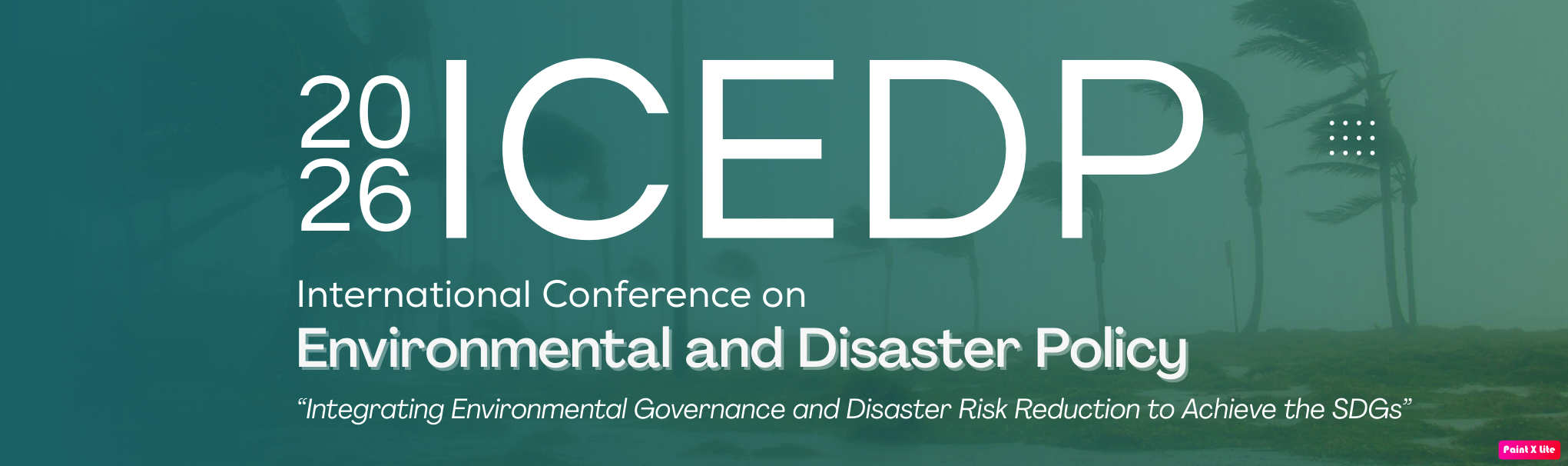
The International Conference on Environmental and Disaster Policy (ICEDP) 2026, themed “Integrating Environmental and Disaster Risk Reduction to Achieve the SDGs,” serves as a strategic platform to advance global dialogue on environmental sustainability and disaster resilience. In response to escalating challenges such as climate change, environmental degradation, and increasing disaster risks, ICEDP 2026 aims to provide a scientific and policy oriented forum that connects research, technology, and decision making processes. The conference promotes collaboration among scholars, policymakers, practitioners, and international organizations to address complex environmental and disaster issues within the framework of the Sustainable Development Goals (SDGs).
The core scope of ICEDP 2026 is structured around two main subject areas: Environmental Science and Disaster Policy. Environmental Science focuses on key issues including renewable energy and waste valorization, biodiversity and indigenous knowledge for future conservation, food security technology for national resilience, land utilization, protection, and restoration, as well as strengthening marine ecosystem resilience in the context of climate change. Disaster Policy highlights technical and policy approaches such as advanced early warning systems and hazard detection technologies, geospatial modeling and disaster risk mapping, resilient infrastructure engineering and risk sensitive design, and disaster data management and decision support systems.
ICEDP 2026 holds significant importance as environmental and disaster challenges increasingly affect social stability, economic development, and ecological balance. The conference encourages systematic, empirical, and policy relevant research that contributes directly to the achievement of the 2030 Agenda. By fostering interdisciplinary collaboration and international partnerships, ICEDP 2026 aims to generate practical policy solutions, strengthen institutional capacity, and support sustainable and resilient development pathways. Through knowledge exchange and collective action, this conference is expected to contribute to building resilient societies and a sustainable future at the global level.