Real Time Smart Career Path Advisor: An AI Driven, Microservice Oriented Platform for Adaptive Learning Based on Industry Trends
Kata Kunci:
Microservices, Architecture, Machine Learning, Natural Language, Processing (NLP), Industry Trend, Analysis Real Time, CareerAbstrak
This study presents the Smart Career Path Advisor, an intelligent platform designed to help Indonesian undergraduates and recent graduates identify optimal career paths aligned with their interests, talents, and current industry trends. Implemented on a Kubernetes‑managed microservices architecture, the system integrates five core modules: (1) User Profile, which collects demographic data, interests, and strengths; (2) Industry Trend Aggregator, which employs Scrapy and BeautifulSoup to harvest job postings from JobStreet, LinkedIn, and local portals and extract in‑demand skills such as ReactJS, Node.js, and Express; (3) Career Recommendation Engine, featuring a TensorFlow pipeline for data ingestion, preprocessing, and inference that combines collaborative filtering and NLP to deliver instant career suggestions with at least 85 % accuracy; (4) Adaptive Learning Planner, which automatically generates personalized learning paths—comprising courses, materials, and certifications—and refines content via reinforcement learning based on user feedback; and (5) Notification & Feedback, which issues real‑time updates via push notifications and email while monitoring user engagement. We evaluate the platform through usability testing with 30 students and quantitative analysis of recommendation accuracy and engagement metrics. The Smart Career Path Advisor not only provides precise, up‑to‑date career insights but also equips users with actionable learning strategies to meet the demands of the modern job market.
Referensi
Devlin, J., Chang, M.-W., Lee, K., & Toutanova, K. (2019). BERT: Pre-training of deep bidirectional transformers for language understanding. In Proceedings of the 2019 Conference of the North American Chapter of the Association for Computational Linguistics: Human Language Technologies (pp. 4171–4186). https://doi.org/10.18653/v1/N19-1423
He, K., & Sun, J. (2015). Convolutional neural networks at constrained time cost. In Proceedings of the IEEE Conference on Computer Vision and Pattern Recognition (pp. 5353–5360). https://doi.org/10.1109/CVPR.2015.7299156
He, K., Zhang, X., Ren, S., & Sun, J. (2016). Deep residual learning for image recognition. In Proceedings of the IEEE Conference on Computer Vision and Pattern Recognition (pp. 770–778). https://doi.org/10.1109/CVPR.2016.90
Hochreiter, S., & Schmidhuber, J. (1997). Long short-term memory. Neural Computation, 9(8), 1735–1780. https://doi.org/10.1162/neco.1997.9.8.1735
LeCun, Y., Bengio, Y., & Hinton, G. (2015). Deep learning. Nature, 521(7553), 436-444 https://doi.org/10.1038/nature14539
Redmon, J., & Farhadi, A. (2018). YOLOv3: An incremental improvement. arXiv preprint arXiv:1804.02767. https://doi.org/10.48550/arXiv.1804.02767
Rumelhart, D. E., Hinton, G. E., & Williams, R. J. (1986). Learning representations by back-propagating errors. Nature, 323(6088), 533–536. https://doi.org/10.1038/323533a0
Schmidhuber, J. (2015). Deep learning in neural networks: An overview. Neural Networks, 61, 85–117. https://doi.org/10.1016/j.neunet.2014.09.003
Smith, L. N. (2017). Cyclical learning rates for training neural networks. In 2017 IEEE Winter Conference on Applications of Computer Vision (WACV) (pp. 464–472). https://doi.org/10.1109/WACV.2017.58
Vaswani, A., Shazeer, N., Parmar, N., Uszkoreit, J., Jones, L., Gomez, A. N., Kaiser, Ł., & Polosukhin, I. (2017). Attention is all you need. In Advances in Neural Information Processing Systems (Vol. 30, pp. 5998–6008). https://doi.org/10.5555/3295222.3295349
Unduhan
Diterbitkan
Cara Mengutip
Terbitan
Bagian
Lisensi
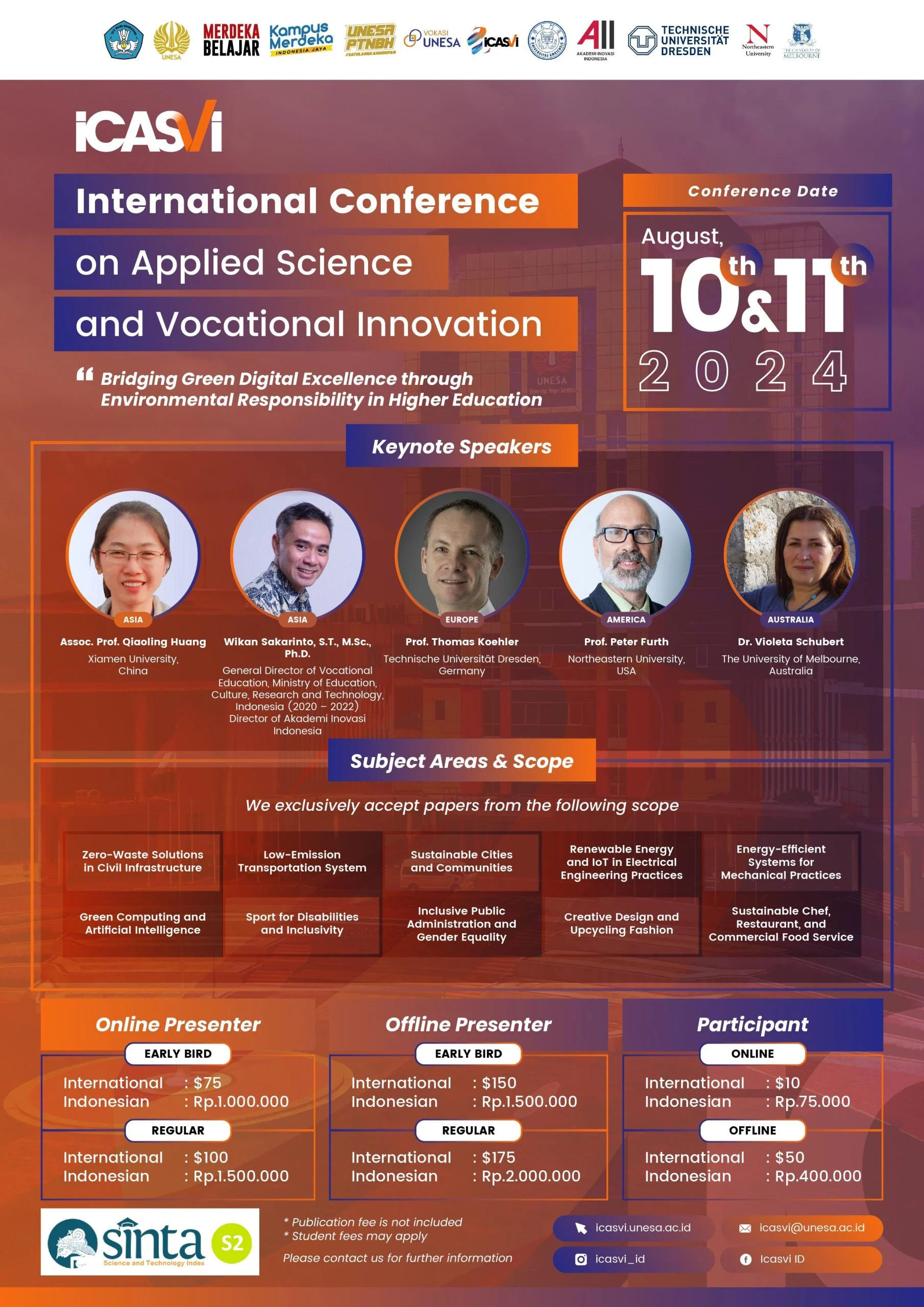
Hak Cipta (c) 2026 Proceedings International Conference on Aligning Sustainability with Vocational Innovations (ICASVI)

Artikel ini berlisensi Creative Commons Attribution-NonCommercial-NoDerivatives 4.0 International License.