About the Journal
FOCUS AND SCOPE
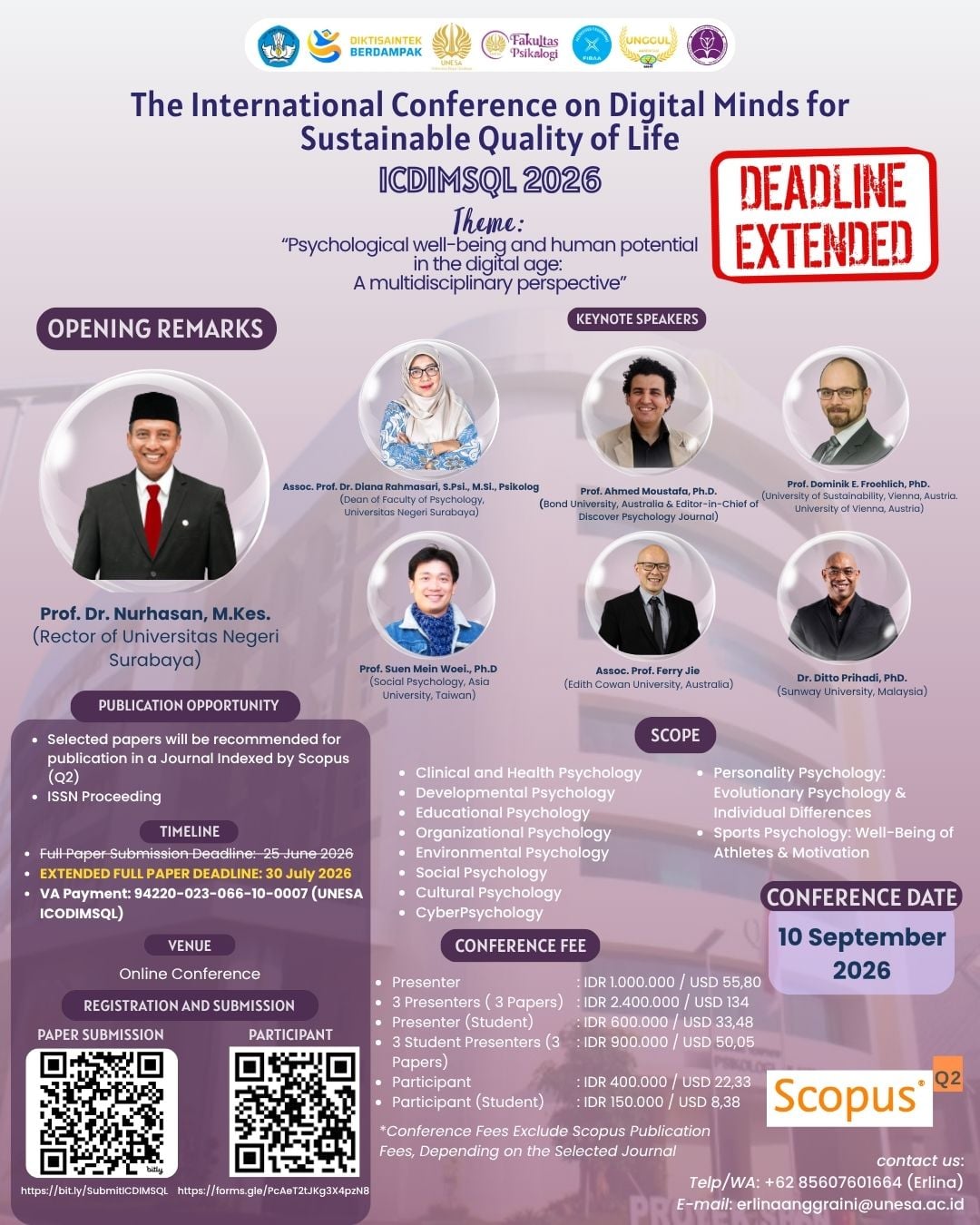
ICDIMSQL 2026 is an international, multidisciplinary academic forum that focuses on the intersection of psychological well-being, human potential, and digital transformation toward a sustainable quality of life. The conference accepts original research, conceptual papers, methodological contributions, and applied studies that address, but are not limited to, the following areas:
- Social psychology in digital contexts
- Industrial and organizational psychology
- Educational and developmental psychology
- Clinical psychology and digital mental health interventions
- General and experimental psychology
- Digital behavior, online social interaction, and well-being
- Ethics, policy, and digital responsibility
- Education, work, and organizational transformation in the digital age
- Methodological and multidisciplinary approaches to digital minds and sustainability
- Human flourishing, positive psychology, and quality of life in digital ecosystems
Only manuscripts that demonstrate thematic coherence, international relevance, methodological soundness, and a significant contribution to the literature on psychology, digital transformation, human flourishing, and sustainable quality of life will be considered for further publication.
PUBLICATION FREQUENCY
The ICoDiMSQL proceedings are published annually following the conference. Selected high-quality manuscripts that pass a rigorous post-conference review and revision process may be submitted for consideration in a Springer publication pathway (e.g., a Scopus-indexed book chapter collection, an edited volume, or a special issue in a Springer journal). The exact publication timeline depends on the editorial assessment, peer-review standards, and contractual requirements of Springer.
REVIEWER GUIDELINES
Reviewers for ICoDiMSQL 2026 will receive the manuscript(s) in MS-Word soft file format. Detailed evaluative comments are required, and comments should be written directly in the file. The conference publication committee will send the commented manuscript(s) to the author(s); therefore, please be as comprehensive, specific, and constructive as possible.
The following format is suggested for preparing comments for the author(s):
-
Identification of the contribution and major strengths of the paper
Is this paper appropriate for the conference theme (Psychological Well-being and Human Potential in the Digital Age)?
What are the main strengths?
What is the primary contribution to existing knowledge in psychology, digital transformation, or quality of life studies? -
Major weaknesses of the paper
Does the manuscript provide sufficient information?
Are there any factual or methodological mistakes that should be corrected?
Do the authors achieve their stated objectives?
What major changes are required in a revision? -
Readability and presentation
Are the references, tables, and figures appropriate and correctly placed?
Can any sections be eliminated or condensed?
Will the paper interest both academicians and practitioners? How can it be improved? -
Abstract and title
Is the title appropriate given the content?
Does the abstract provide an accurate and useful summary?
If you, as a reviewer, believe it is necessary to alert the editor to issues that should not be included in the comments to the author(s), please write a separate note to the editor.
DUTIES OF REVIEWER
Contribution to Editorial Decisions
Peer review assists the scientific committee and publication editor in making editorial decisions and helps the author improve the paper.
Promptness
Any reviewer who feels unqualified to review a manuscript or knows that a prompt review is impossible must notify the editor and excuse themselves from the review process.
Confidentiality
All manuscripts received for review must be treated as confidential documents. They must not be shown to or discussed with others except as authorized by the editor.
Standards of Objectivity
Reviews must be conducted objectively. Personal criticism of the author is inappropriate. Referees should express their views clearly with supporting arguments.
Acknowledgement of Sources
Reviewers should identify relevant published work that has not been cited by the authors. Any statement that an observation, derivation, or argument has been previously reported must be accompanied by the relevant citation. Reviewers must also alert the editor to any substantial similarity or overlap between the manuscript under consideration and any other published paper of which they have personal knowledge.
Disclosure and Conflict of Interest
Privileged information or ideas obtained through peer review must be kept confidential and not used for personal advantage. Reviewers must not consider manuscripts in which they have conflicts of interest resulting from competitive, collaborative, or other relationships with any of the authors, institutions, or companies connected to the papers.
PEER REVIEW AND SELECTED PAPERS PROCEDURE
All submitted full papers will undergo a rigorous, multi-stage quality control process before being recommended for Springer consideration:
-
Abstract screening – relevance to theme and scope
-
Full paper submission – template compliance and similarity check (Turnitin/iThenticate)
-
Peer review – methodological rigor, theoretical contribution, and writing quality
-
Conference presentation – scholarly feedback from discussants, reviewers, and participants
-
Selection of recommended papers – only strong manuscripts proceed to editorial development
-
Post-conference revision – substantial revision based on reviews and editorial guidance
-
Final editorial review – coherence, ethics, formatting, and readiness for publisher submission
The acceptance of a paper depends on:
-
Novelty and relevance to the conference theme
-
Methodological soundness and validity
-
Originality and contribution to the field
-
Clarity of description
-
Conformity with the conference’s multidisciplinary objectives
Papers may be accepted without revision, accepted with minor revision, accepted with major revision, or rejected. Authors of selected papers will be notified via email and given an opportunity to revise their manuscript based on reviewers’ and editors’ suggestions, typically within 2–4 weeks after the conference.
PLAGIARISM AND ETHICAL COMPLIANCE
All incoming manuscripts will be checked for authenticity using Turnitin and/or iThenticate anti-plagiarism software. A similarity index exceeding 20% (excluding references) will result in rejection or mandatory revision.
Studies involving human participants must provide evidence of ethical approval from an appropriate institutional review board (IRB) or ethics committee. Authors must disclose any conflicts of interest.